

The Story We Were Told About Women Was Never the Evidence
Four thousand years ago, a woman was buried on the chalk downland of Salisbury Plain, less than ten miles from Stonehenge, and she was laid to rest with her tools.
Not a token spindle or a pot, but her actual working kit. A touchstone for testing the purity of precious metals, which is the ancient equivalent of an assay office. Stone burnishers for smoothing gold. Small cups made from fossilised sea sponges, probably for mixing adhesives or pigments. A greenstone battle axe from Cornwall that had been repurposed as a hammer for beating gold into sheets. Traces of gold still cling to several of the objects, and her right wrist showed the arthritis of a lifetime of repetitive craft work.
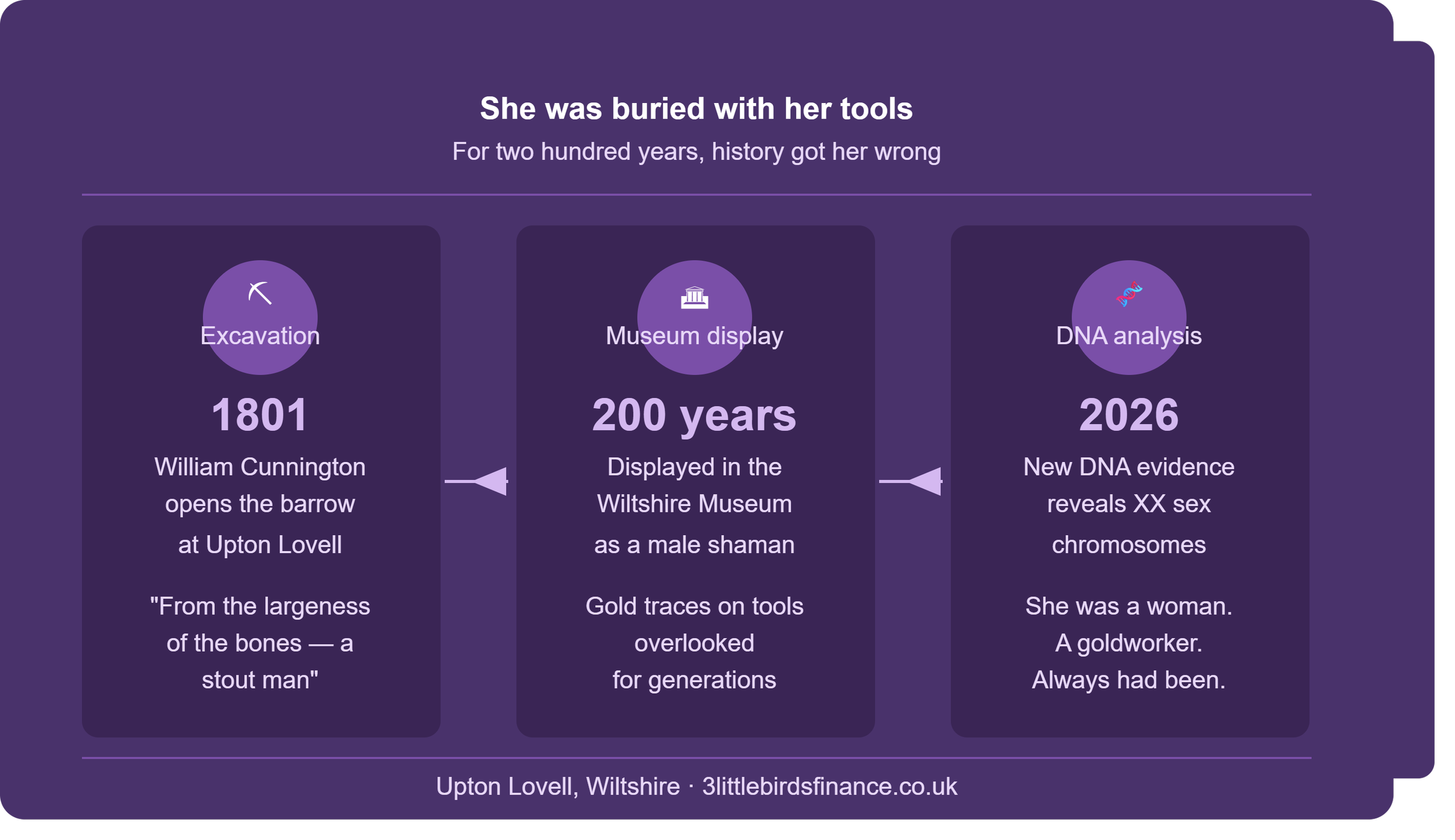
When the barrow was opened in the early 1800s, the antiquarian who found her looked at the size of the bones and concluded she was a stout man, labelling the burial a shaman. That interpretation stuck for more than two hundred years, through countless books, display cases and school trips.
Then in August 2026, somebody ran the DNA.
She was a woman.
If you want to know why an accountancy practice is writing about Bronze Age gold, and TL;DR - skip to the end.
If you want the full story, stay with us.
The story we inherited was never the evidence
Nobody lied or forged anything. A perfectly competent man looked at a highly skilled metalworker buried with a fortune in specialist tools, and the only conclusion available to him was that this must be a man, because in his world, women did not work gold.
The evidence had been sitting in a museum in Devizes the whole time. What changed was not the bones. What changed was the assumption laid over the top of them.
We think about that a lot in our line of work, because we meet it constantly in a smaller and much more modern form. The woman who apologises before she tells us her turnover. The one who calls her business a little side thing when it is comfortably supporting a household. The one who assumed the mortgage adviser would want to speak to her husband, because that is what happened last time.
None of that comes from evidence either. It comes from a story.
Where else the story does not hold
If male authority were genuinely the natural order of things, we would expect to find it everywhere, in every society, at every point in history. We do not.
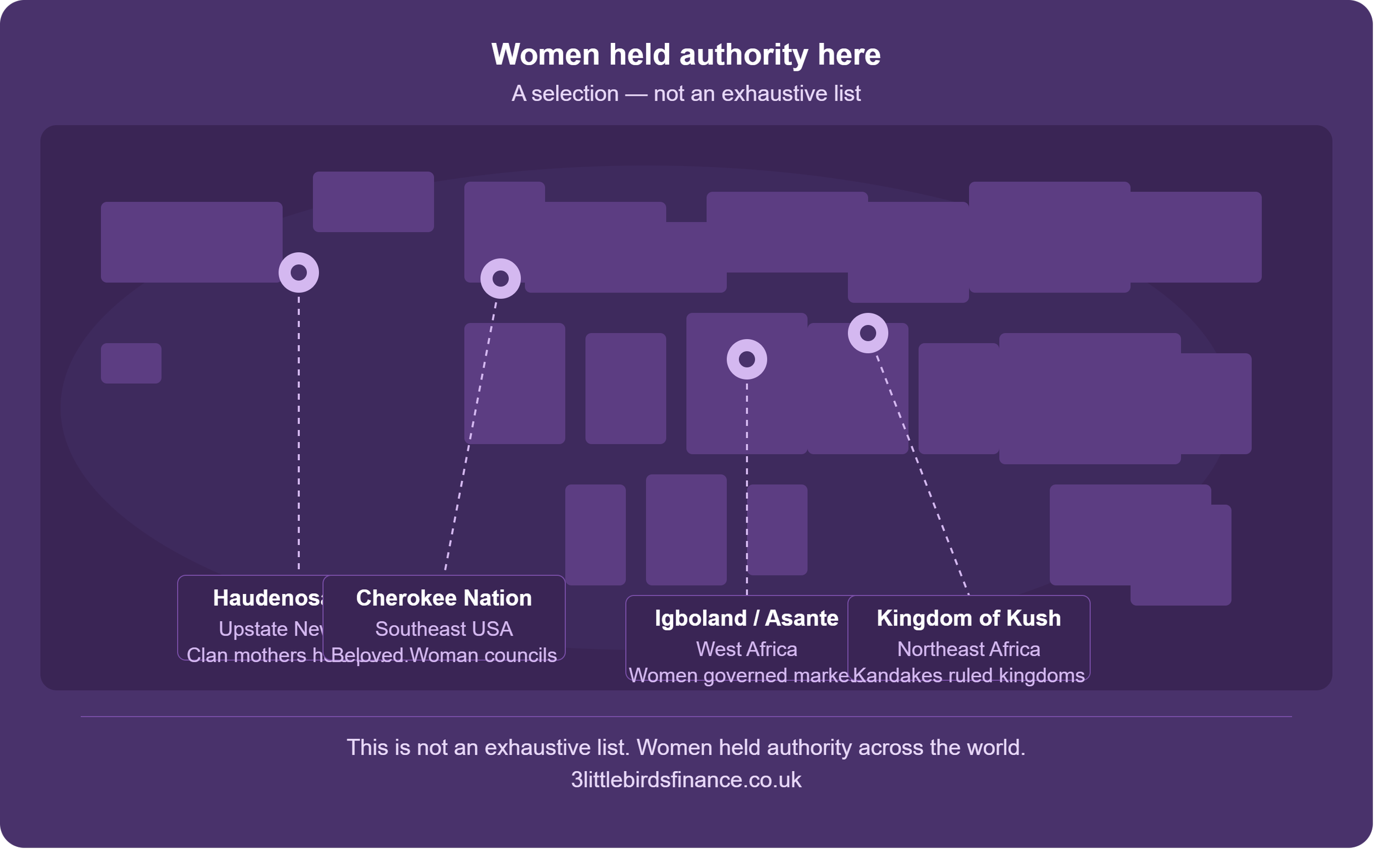
Among the Haudenosaunee, the confederacy in what is now upstate New York and southern Ontario, descent ran through the mother, the longhouses and fields were held by the women of the clan, and clan mothers chose the men who would represent them in council. If a leader failed to serve his people well, the clan mothers removed him. He held the position while they held the power to grant and withdraw it, and that was not a ceremonial courtesy but a constitution.
It is worth pausing on what that actually looked like in practice, because matriarchy is a word that tends to conjure an image of women doing to men what men have so often done to women. That is not what the evidence shows. What it shows, repeatedly, is something closer to balance and interdependence, communities organised around different assumptions about where authority naturally sits and who is responsible for what. The point is not that women had power over men. The point is that the default assumption, that authority belongs to men and must be delegated to women as an exception, was simply not present.
Among the Cherokee, clan membership passed through the mother, women held their own council, and the title of Beloved Woman carried genuine weight in decisions of war and peace. Nanyehi, known to the settlers as Nancy Ward, spoke in peace negotiations at a time when no woman in Britain could vote or hold property in her own name after marriage.
In Igboland, in what is now south eastern Nigeria, political life was organised so that women governed women. Alongside the male leadership sat the Omu and her council, with authority over the markets, trade disputes and matters affecting women. Women's associations met, ruled and enforced, and if a man behaved badly enough the women of the community could act collectively against him with considerable effect. When the British arrived, they installed a system of warrant chiefs, appointing men because that was what leadership looked like to them, and simply did not see the women's half of the structure. It was not abolished by argument but by simply not being noticed. When taxation was extended to women in 1929, tens of thousands of them organised across the region in what became known as the Women's War, because they were used to having a voice and had just discovered it had been written out of the record.
Among the Asante in what is now Ghana, the Asantehemaa nominated the king and could challenge him in council, and when the British demanded the Golden Stool in 1900 it was Yaa Asantewaa who led the resistance. Further back, the kingdom of Kush was ruled by a line of queens, the kandakes, one of whom fought Rome to a standstill.
Across West Africa, the markets have always run on women's money, and in the twentieth century a group of Togolese traders became so dominant in the wax print cloth trade that they were nicknamed the Nana Benz, after the cars they bought with the profits.
Women controlling capital, setting prices, and financing the next generation is not a new idea that anyone needs to be eased into gently.
What this actually means
We want to be clear about something. We are not saying men are the villain of this story in some simple, universal sense. The picture is more complicated than that, and the evidence shows it.
What the evidence does show is that in many of the places where women held political authority, economic power and genuine voice, that authority was systematically removed, not gradually outgrown. It arrived with conquest, with colonial administration, with legal frameworks that turned women into dependants and called it the natural order. The British installed warrant chiefs in Igboland and did not notice the women's councils because they were not looking for them. That is not a conspiracy. It is something more mundane and in some ways more damaging: a set of assumptions so deeply held that they made half of what was in front of them invisible.
The domestic sphere did not emerge because women were suited to it. In many places it was constructed around them, sometimes within living memory.
Male dominance is not a law of nature. It is one arrangement among several, and in a good many of the places where it looks ancient and immovable, it turns out to have arrived surprisingly recently, often in the luggage of somebody else's empire.
A thing that had a beginning can have an ending, and that is all a trend is.
Why we are writing about Bronze Age gold on an accountancy blog
Because the gap between what women actually do and what women are assumed to do is our daily work.
We see the real numbers. We see the woman who described her business as ticking along, whose books show she has quietly built something with better margins than most of the companies that would never think to ask her advice. We see the skill, the risk taken, the household carried, the decisions made at eleven o'clock at night with nobody to check them against.
And we see how often that woman still speaks about herself as though she needed permission to be doing it.
The goldworker at Upton Lovell did not need permission. The clan mothers did not need permission. The women of the Igbo markets and the Asante court did not need permission. They had authority because they had skill and because their communities were sensible enough to recognise it.
You already have the skill, and the recognition is the bit that has been unreliable, for reasons that have nothing to do with you and quite a lot to do with a man in 1801 looking at a set of large bones and deciding what he already believed.
Get the story straight. The numbers were always on your side.
Here when you need us,
3 Little Birds Finance
TL;DR
A Bronze Age woman was buried near Stonehenge with a full goldsmith's toolkit. For 200 years, history called her a man. DNA proved otherwise in August 2026.
This is not an anomaly. Across history, women have held political power, run economies, governed communities and led armies. The idea that male authority is the natural order is not ancient truth. It is one story that won, often recently and often by force.
The reason this matters on an accountancy blog is simple. We work with women every day who undervalue what they have built, speak about their businesses apologetically, and carry authority they have not yet given themselves permission to claim.
The goldworker at Upton Lovell did not wait for permission. Neither should you.
